Argh. Cliff Asness is a true supervillain - he has succeeded in forcing me to think about health care. On Twitter, I repeated the factoid that America's health care system is worse than that of other advanced nations, and Cliff directed me to
this article of his, alleging that this talking point is a myth. The whole article is too big to take on in one post, so I'll stick to looking exclusively at his "Myth #4":
Myth #4: Healthcare costs are very high in the United States compared to socialized countries
This section itself is broken into multiple points, so let's take a look at them.
Many of the surveys of “outcomes” that show other countries spend less for similar or better healthcare than the United States are just intentionally disingenuous (i.e., they lie). The ultimate example is the U.N.’s 2000 World Health Report, which has been extensively cited by progressives and the media...[T]he study included high-speed auto fatalities and murders in their assessment of a country’s life expectancy, and then progressives cited that life expectancy to indict the U.S. healthcare system. Well, Americans drive more often on a more extensive highway system than most others, and we sadly have more crime than many. Reputable studies exclude these fatalities as, while tragic, they are not the fault of the healthcare system and should not be used to judge or modify the healthcare system. With these fatalities excluded, the U.S. ranks 1st in the world on life expectancy. With them included, we rank 19th, as reported in the 2000 study cited so often by ObamaCare advocates.
Actually, with both violent fatalities (which include suicide) and traffic fatalities included, we rank 42nd. But anyway, Cliff's point is an important one. Still, I don't think he makes the case. Here's why.
First of all, this study, by Robert Ohsfeldt and John Schneider, uses data from 1980-1999; hence, it is between 34 and 15 years out of date. There is
some evidence that the U.S. has fallen behind a bit since then. One way to see the old-ness of the study is to observe that the gap between the U.S. and the other rich countries was very small,
with or without traffic and violent fatalities!
Read
this WSJ article for a balanced look at the Ohsfeldt and Schneider study. Also, a quick Google will find some studies that look at more disaggregated metrics - for example,
this 2012 study, which gives survival rates for various types of cancer. There are many, many other sources like this out there.
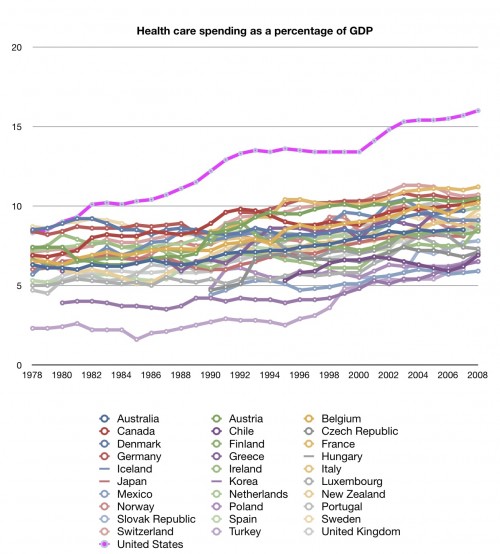
The upshot, though, is that in terms of life expectancy, and most other outcomes, the U.S. and European/Asian systems are doing about equally well. The U.S. simply spends a
much much larger portion of its GDP to achieve this performance. Similar results for 1.5 or 2 times the price? That's a crap outcome, as a businessman like Cliff should know!
Cliff also accuses the U.N. of basically lying to make the U.S. health system look bad:
Perhaps even more insidiously, most of the U.N.’s 2000 World Health Report does not really even rank healthcare outcomes. The actual oft-quoted final rankings, with the United States ranking poorly, are an average of many different ratings, many of them explicitly about how “socialized” or “progressive” a healthcare system is. For instance, their rating system gives 25 percent weight to “financial fairness,” and if one goes through their other categories you find they again are not rating who lives or dies or lives better (you know, healthcare outcomes), but how much the healthcare system has such things as “respect for persons” (this is part of the 12.5 percent weight they gave to “responsiveness,” which is separate from the 12.5 percent weight they gave to “responsiveness distribution,” whatever on Earth that is). The report goes further, judging these things with such objective measures as “respect for dignity” and “autonomy.” In total, more than 60 percent of a country’s score in this survey was some measure of progressive desires, not what you or I would call a healthcare outcome. And, as in our auto example above, much of the rest contained expressly anti-American flaws. That we pay for the United Nations to lie about us is a topic for another day.
I don't have anything to say about this, but I never heard about those ratings anyway, and I don't think advocates of U.S. health reform really talk about them much. So I will skip over this part.
Cliff's later points address this somewhat, so let's proceed:
Part of the reason we spend more is other countries have price controls and we don’t. For instance, they restrict the amount drug companies can charge much more than we do. That sounds great; price controls save us money! But if nobody pays for new drugs, they don’t ever get created. Without these controls, our consumers here indeed pay more, but that funds much of the life-saving and life-extending healthcare innovation available for Americans and the rest of the world. It is frankly unfair that the world is free-riding off us. Free-riding means they let us pay for the innovation that benefits them at lower cost. But if nobody pays for the innovation, the innovation just does not happen. If we try to free-ride off ourselves, it doesn’t work—innovation dies for us too. U.S. consumers paying fair prices (not government restricted artificially low prices) does lead to higher U.S. healthcare costs, but the alternative is far worse: Joining the world in severely limiting prices, and not seeing the next generations of new innovations and improvements.
This is another important point, though I wish Cliff had provided some evidence.
The U.S. spends 18% of GDP on health care; Germany spends 11%. Are you telling me that we spend 7% of our GDP - one trillion dollars a year - on health innovation? Actually, since some health innovation is done in other OECD countries, it's an even bolder claim - that $1T should represent the
difference between what we spend on health innovation and what we would spend if we were able to "free ride" as much as Germany. That's a lot of health innovation spending. Health research spending is
only about a tenth of that, actually. (Research is not the only type of innovation, of course, but it seems like the bulk of it, especially given that many R&D expenses are tax-deductible, so it's in companies' interest to classify as much innovation as "research" as possible.)
So the argument is that our
exorbitant health care prices go to fund innovation, which Europe and Japan then get for cheap or free, by free-riding. But how does this free-riding work? How do they just take our technology?? Maybe ideas are just in the air, and technology spreads by casual conversation among doctors at international conferences, by cheap reverse-engineering, by industrial espionage, etc.
But if this is true, then health technology is non-rival and non-excludable - it's a
public good! And a public good is a market failure. And if health technology is a giant, $1 trillion market failure, we shouldn't expect a free-market system to work very well. You can try to patch things with a patent system, but that will always be an incomplete solution. So if all this free-riding is going on, it's a powerful argument that much medical innovation should be done by the government, not by private companies.
Cliff continues:
Americans lead less healthy lifestyles than much of the developed world. Americans historically value freedom more than other countries and cultures. We value it for its own sake, even if it sometimes leads to a worse outcome. But we mostly value it because these choices are personal. Frankly, some would sacrifice some health to eat what they want and avoid the StairMaster. Freedom isn’t always sugar-free. Our American choices are costing us more, and raising the healthcare cost figures progressives love to cite. But they are our choices to make, not theirs to gainsay.
I will spare the snarky comments about public health, hand-washing, sewer systems, the CDC, blah blah blah. Those comments write themselves.
What's less clear is that people in Europe and Japan are less free. Getting good health advice from your doctor isn't slavery. Being taught healthy habits in school isn't slavery. If you think either one of those things is slavery, you're a doofus. A doofus who is entitled to his doofus opinion, but a doofus nonetheless. (Note: This is a value judgment!)
(Actually in some ways we live healthier lifestyles than people in other countries. We
smoke less, for example. Obesity is the main difference. It's a little amusing how the right has turned to extolling the virtues of land-whale-itude in recent decades...)
Cliff:
We spend more on end-of-life care than more regulated societies with socialized medicine or systems closer to it. That’s our choice.
Is it? A lot of that higher spending is higher prices, which could reflect higher demand, or which could reflect inefficiencies in the system (or paying for innovation, but I covered that above). I'm going to go with "inefficiencies," since Americans
usually don't even know the prices of the health care services they buy. How can you make an informed, free consumer choice when you don't even know the price of what you're buying?
Cliff:
The cost of a healthcare system is not just what we spend directly on it, it is also how much the healthcare system helps or hurts the overall economy. If socialized medicine slows economic growth, then this is part of its cost, perhaps a big part, and is left out of the simple analyses (looking at direct expenditure divided by GDP) that are so common.
But if the government forbade us from spending money on health care, we'd just spend it on other stuff we like. In real terms, if government forbade us from using real resources to create health care services, we'd use those resources on something else we want a bit less. Substitution would mitigate the effect of price controls, etc., not exacerbate them.
Cliff:
Lawyers. We got lots, they have far fewer. We can separately debate how to design our legal system (some of my libertarian friends advocate for a large role for lawyers), but the size and scope of legal action here dwarfs most of the world. It leads to doctors practicing tremendous amounts of “defensive medicine.”
This is a sensible point, but as with most of these points, it's not backed up by any numbers or evidence. Tort reform could theoretically be a big money-saver, but
in practice it doesn't look like a game-changer.
This brings us to the end of Cliff's so-called "Myth #4". The main take-away is:
1. We pay much much more than other countries for about the same quality of health care.
2.
Some part of this may be due to innovation externalities, but these must necessarily represent a market failure.
Anyway, I do think Cliff's points are important. I think medical innovation is very important and under-studied, and I do think it represents some (though not most) of the price difference between America and other countries. I do think that tort reform is a good idea and should be tried. I do think that the difference between America and the rest of the OECD is
not in health outcomes, it's in the cost we pay to achieve those outcomes. And I do think that the medical system can't entirely fix the obesity problem.
But these points do not convince me that the American health system is doing better than those of other rich countries. Cliff's main point is that the American quasi-market system, while not perfect, does many things better than the non-market systems of places like Germany, the UK, or Japan. But it seems to me that getting "bang for the buck" for the modal or median person is not one of these things. Cliff's "Myth #4" seems like no myth, but fact.